
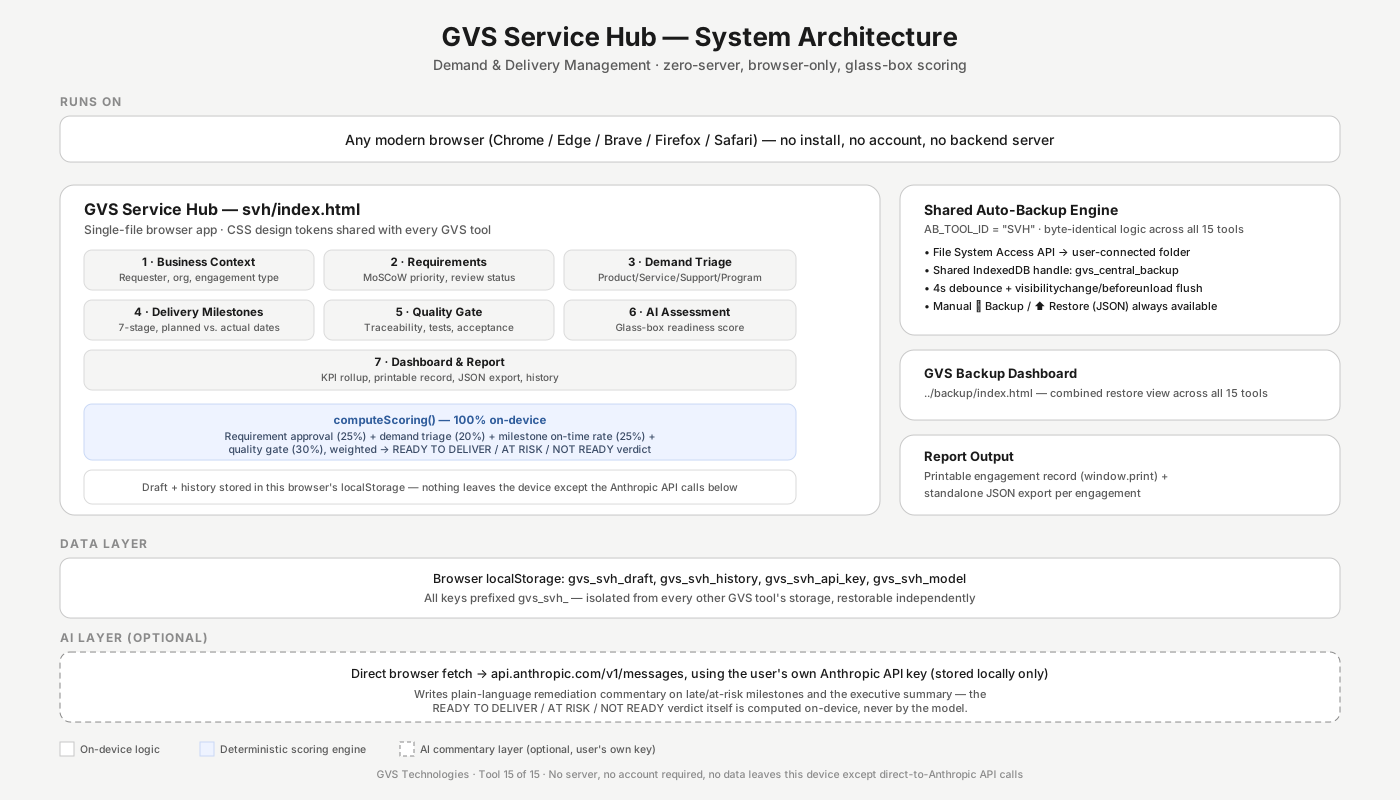
Demand & delivery management — runs entirely in your browser
Collect business requirements, triage demand across Product, Service, Support and Program lines, plan delivery against on-time milestones, run a quality gate, and get a glass-box AI delivery-readiness assessment. One record per engagement: what the client asked for, how it was prioritized, when it's due, and whether it actually met the bar. Your data is stored only in this browser's local storage — nothing is sent to a GVS server. The only outbound call is to Anthropic's API, made directly from your browser using your own key.
// Step 1 — Requester & business context
Who's asking, and what outcome they actually need. This drives nothing in the scoring itself — the verdict always comes from the requirements, demand, milestone, and quality-gate data in later steps.
// Step 2 — Business requirement collection
Every requirement the client has raised, prioritized MoSCoW-style (Must / Should / Could / Won't) and tracked through review to approval. The Requirement Approval Rate in Step 6 is computed on-device from the Status column below.
| Requirement | Category | Priority | Status |
|---|
// Step 3 — Demand triage & prioritization
Four weighted demand lines — Product, Service, Support, Program — the same split GVS Technologies actually delivers against. Uncheck a line if it doesn't apply — weights automatically rebalance. Review each triage criterion Pass / Fail / N/A.
// Step 4 — Delivery plan & milestones
Seven delivery stages, each with a planned date and — once done — an actual date. On Time / Late / At Risk status is computed on-device by comparing the two, not entered by hand.
0 of 7 stages complete
// Step 5 — Quality gate
Four weighted categories the deliverable is checked against before it's called done — Requirement Traceability, Test Coverage & Defect Quality, Customer Acceptance, and Documentation & Handover.
// Step 6 — Glass-box delivery-readiness assessment
The READY TO DELIVER / AT RISK / NOT READY verdict and every score below are computed deterministically from your requirements, demand-triage, milestone, and quality-gate data — Claude only writes remediation commentary for late/at-risk milestones, and the executive summary.
// Step 7 — Dashboard & report
Requirement approval, demand readiness, milestone on-time rate, and quality-gate score rolled up into KPIs, plus the final printable delivery record.